
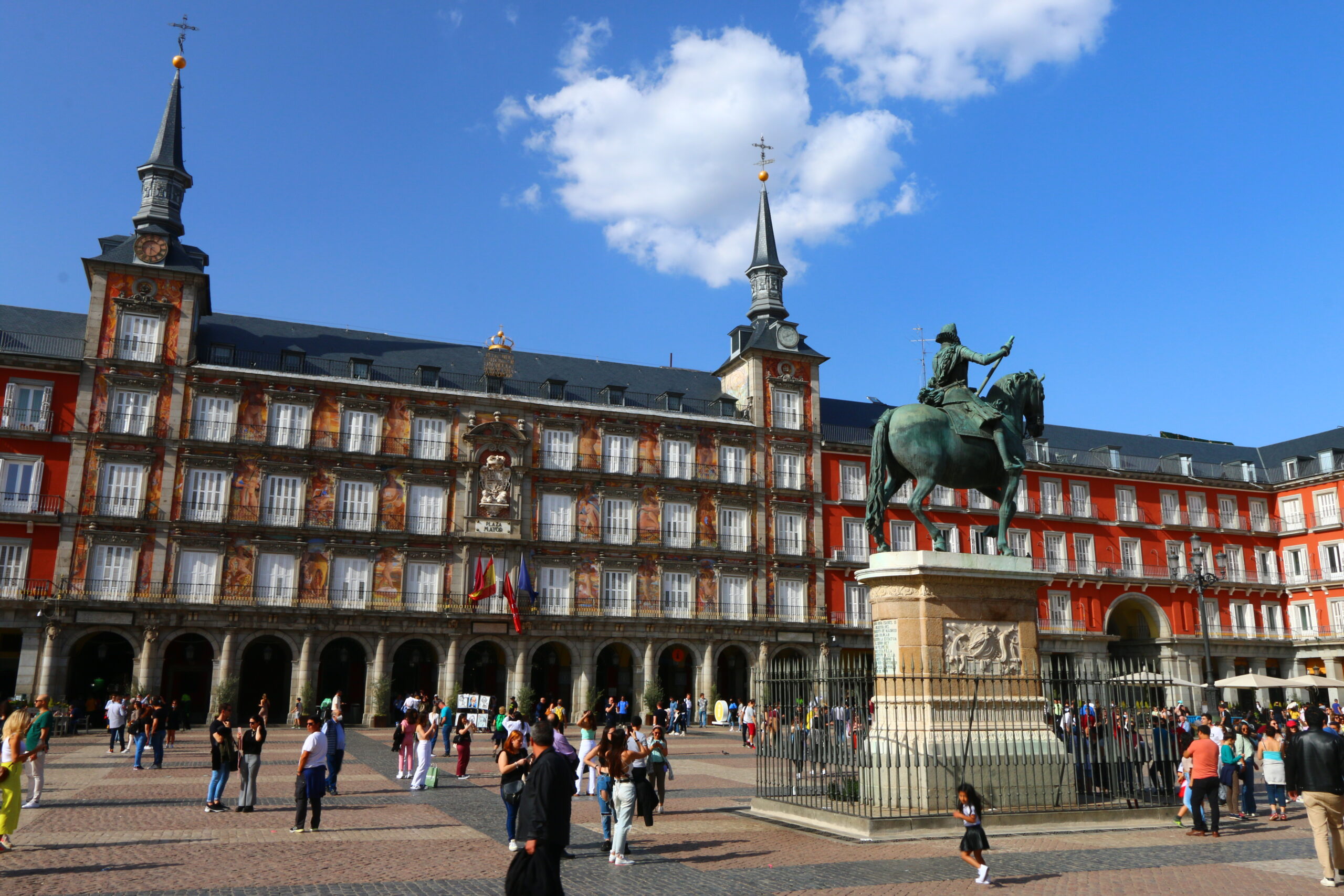
Photo: Benjamin Smith / Wikimedia Commons, CC BY-SA 4.0. Photographed in 2022; resized.
Plaza Mayor rewards a second look. Beyond the familiar sweep of red façades, Madrid’s grand square offers a compact lesson in how a city makes room for public life: sheltering arcades, balconies facing an open centre and narrow entrances that turn arrival into a small architectural event. Give it time at the edges as well as in the middle.
The most rewarding approach is to read the square in layers. First take in the long lines of windows and the dark roofs. Then look closer at the painted figures on Casa de la Panadería. Finally, follow the change of level through the Arco de Cuchilleros. Within a small area, the experience shifts from formal civic space to something much more intimate.
Start with the frame
The square occupies the site of the former Plaza del Arrabal market. Juan Gómez de Mora gave the space its architectural unity under Philip III; after the devastating fire of 1790, Juan de Villanueva shaped its reconstruction. The result is a place whose coherence is immediately visible, even before you know its history.
From the open centre, repeated balconies and the continuous arcade hold the composition together. The stone at pavement level gives way to warmer colour above, while the slate roofs draw a quieter line against the sky. Move under the arches and that grand composition becomes a succession of smaller views: columns in the foreground, light beyond and the square framed differently at every opening.
The equestrian statue of Philip III is a useful point from which to orient yourself. Completed in 1616 by Pietro Tacca after work begun by Giambologna, it arrived here from Casa de Campo in 1848. It gives the generous open space a focal point without obscuring the buildings around it.
A painted façade with a working life
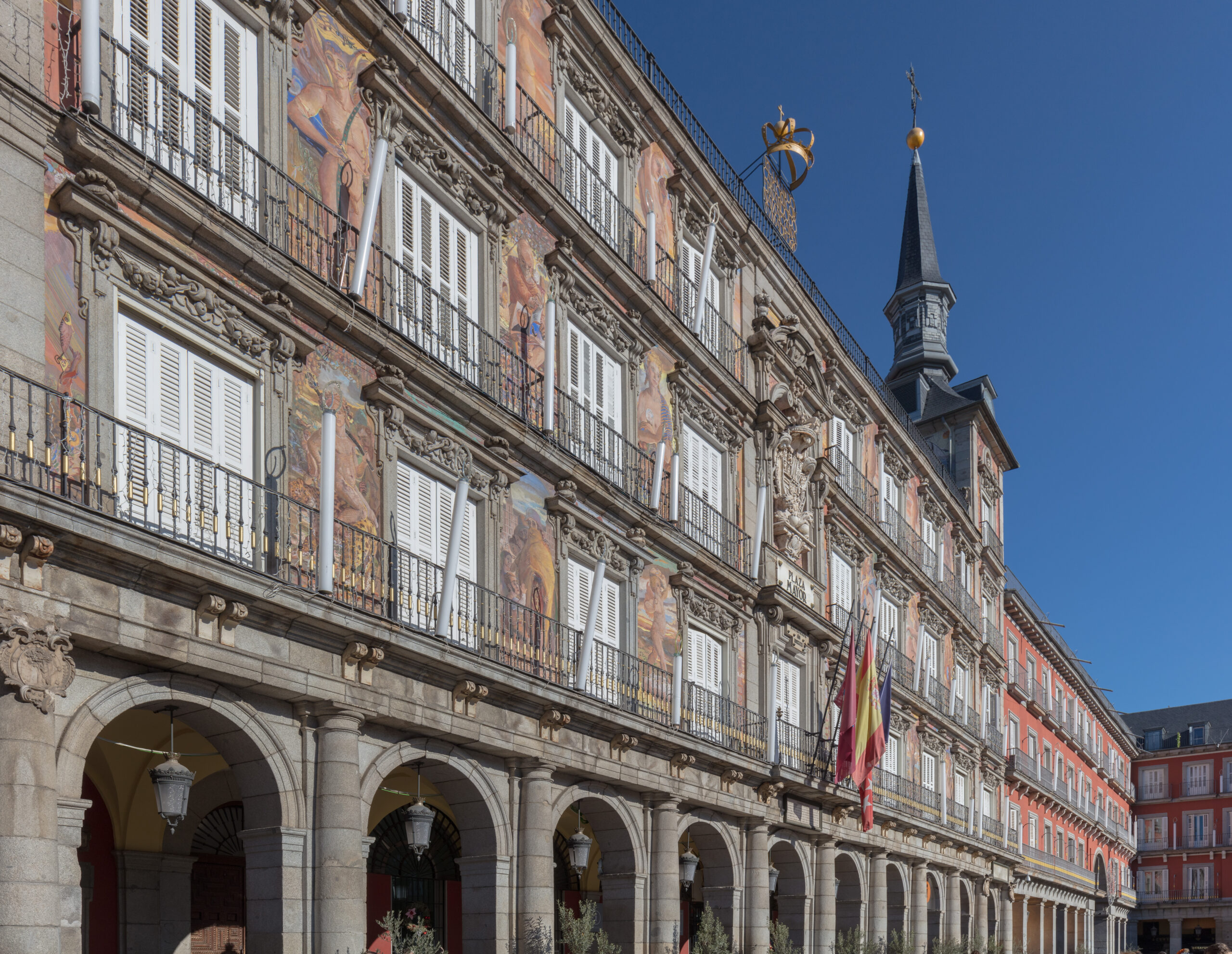
Casa de la Panadería gives the square its most expressive face. Its name recalls the principal bakery once housed on the ground floor. The building later accommodated learned institutions and municipal collections; its history is woven into Madrid’s everyday administration as well as its ceremonial life.
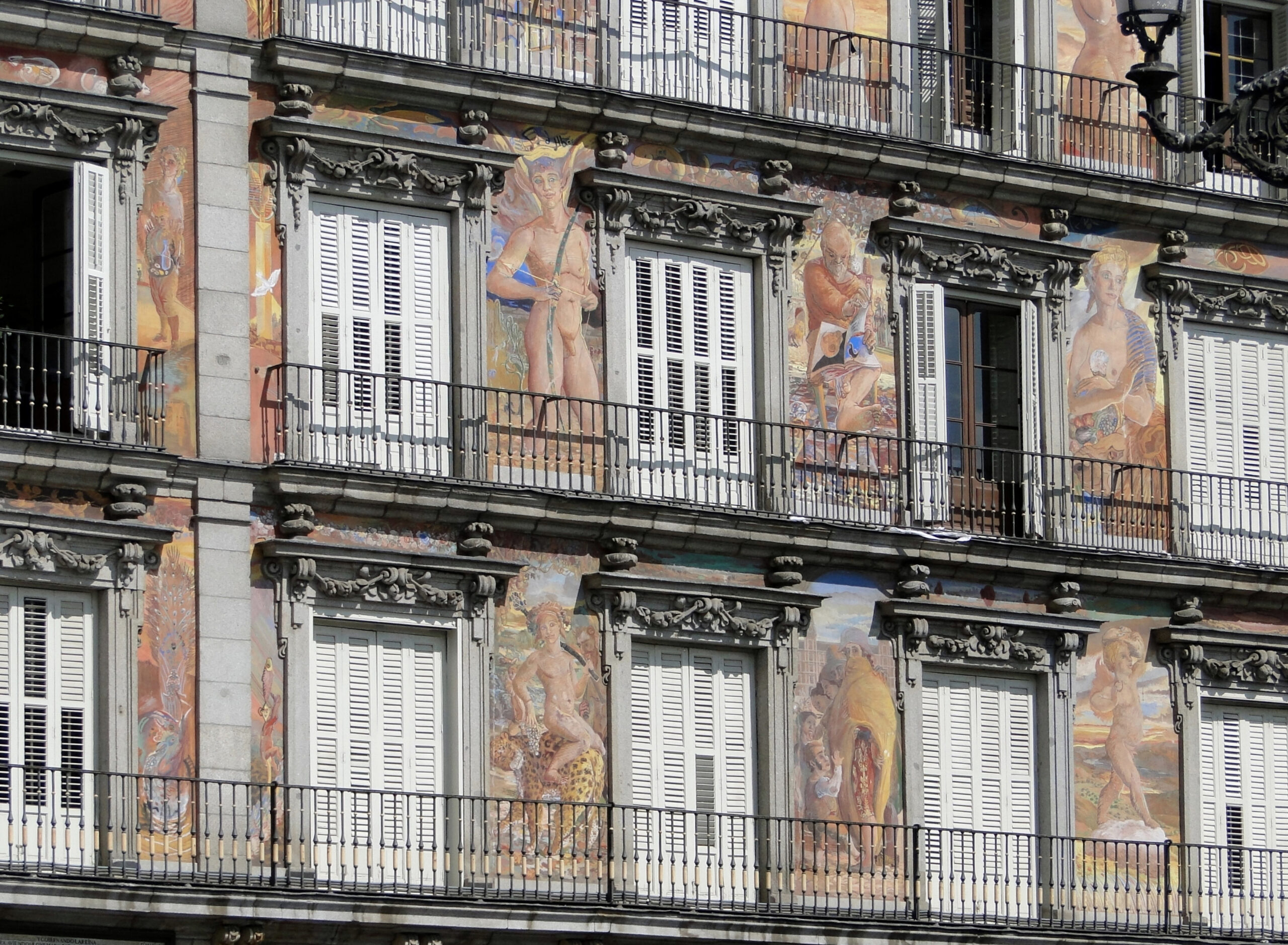
Today’s murals are by Carlos Franco. Mythological figures, including Cybele, inhabit the spaces between the windows, turning the façade into a story you can read in fragments. The contrast is particularly appealing: disciplined rows of shutters and balconies set against figures that seem to escape the building’s rigid geometry.
Step back for the towers, then come closer for individual details. Looking up from directly beneath the façade gives the painting a different scale from the view across the square. Neither replaces the other; together they reveal why this building deserves more than a passing photograph.
There is a practical reason to step inside at ground level. The Salón de Columnas houses the Plaza Mayor Tourist Information Centre, with multilingual advice, maps and an official shop featuring work by local artisans. The shop’s design is by architect Izaskun Chinchilla. The visitor centre offers a useful introduction to the neighbourhood; the upper ceremonial rooms have separate uses and should not be treated as a freely accessible house museum.
Follow the steps at Cuchilleros
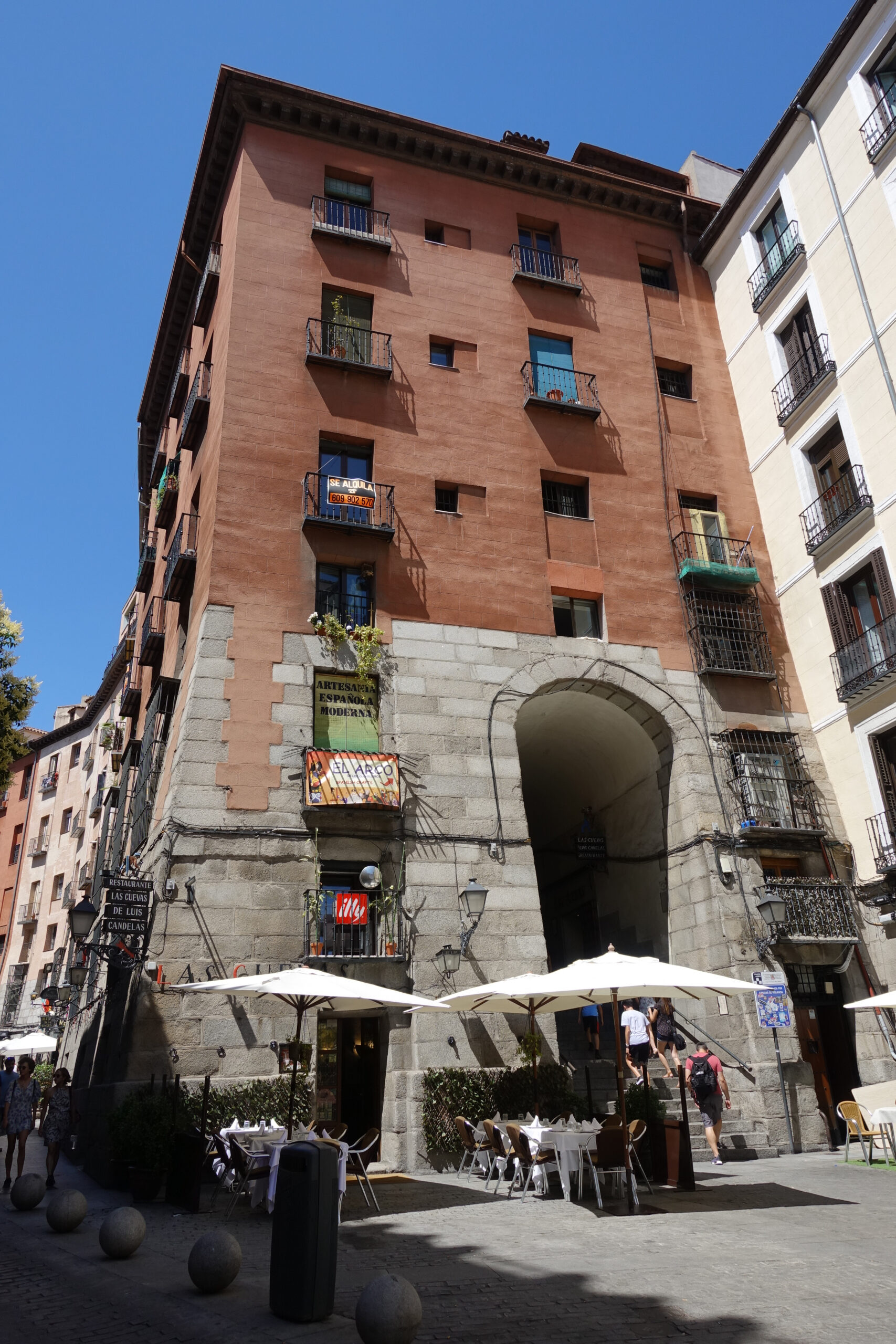
The Arco de Cuchilleros changes the scale of the walk. Its steep steps connect the plaza with the street below, making the difference in ground level part of the architecture. Look back from outside and the arch sits within a tall, substantial façade: an entrance with the presence of a building in its own right.
For a Sunday extension, nearby Plaza del Conde de Barajas hosts the Painters’ Market. Madrid’s official tourism listing gives its regular hours as 10am–3pm, with free admission. The Taller Abierto collective has exhibited here since 1984. It is a fitting continuation of a walk that begins with a painted façade and ends with contemporary artists showing their work outdoors.
Plan a thoughtful visit
Sol and Ópera are useful Metro stations for the area. The tourist information centre at Plaza Mayor 27 currently lists daily hours of 10am–8pm, with different hours on certain Christmas and New Year dates. The Cuchilleros route includes stairs; visitors who need a step-free approach should ask the centre for an appropriate route.
Leave room to pause beneath the arcades rather than treating the square as a single viewpoint. Its strongest detail is the relationship between the whole and the parts: a grand setting that becomes more interesting as you pay attention to a doorway, a painted figure or the next turn into the surrounding streets.
Details checked 24 November 2026.
For help shaping a Madrid visit, enquire with Diana.
 English


